

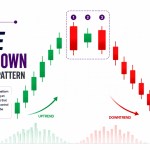
The Side By Side White Lines candlestick pattern is a three-candle continuation pattern that can appear during either an uptrend or a downtrend. Its name comes from the two consecutive white, or bullish, candles that form alongside each other after a price gap.
The pattern has two main variations:
- Bullish Side By Side White Lines — suggests continuation of an uptrend.
- Bearish Side By Side White Lines — suggests continuation of a downtrend.
The important point is that the color of the second and third candles alone does not determine whether the pattern is bullish or bearish. The existing trend and the direction of the gap are critical to interpreting the setup.
If you’re still learning how candlesticks work, it helps to first understand the broader group of candlestick patterns, including how candle bodies, wicks, gaps, and trend context are interpreted.
What Is the Side By Side White Lines Candlestick Pattern?
The Side By Side White Lines pattern is generally made up of three candles.
The first candle follows the existing trend. The next two candles are bullish or white candles with similar characteristics. Depending on whether the two candles gap higher or lower relative to the first candle, the pattern can indicate continuation of either an uptrend or a downtrend.
Basic structure
| Feature | Bullish Version | Bearish Version |
|---|---|---|
| Existing trend | Uptrend | Downtrend |
| First candle | Bullish | Bearish |
| Second candle | Bullish | Bullish |
| Third candle | Bullish | Bullish |
| Gap | Gap up | Gap down |
| Expected interpretation | Bullish continuation | Bearish continuation |
The pattern is relatively uncommon, which means traders should generally avoid treating every three-candle sequence with similar-looking candles as a genuine Side By Side White Lines setup.
How to Identify the Pattern
There are several characteristics to check before labeling a chart formation as Side By Side White Lines.
1. Look for an established trend
The pattern should appear in the context of an existing trend.
For the bullish version, the market should already be moving upward.
For the bearish version, the market should already be moving downward.
Trend context matters because the same-looking candles can have a different interpretation depending on where they appear on the chart.
2. Examine the first candle
The first candle helps establish the direction of the existing trend.
- Bullish version: the first candle is bullish.
- Bearish version: the first candle is bearish.
3. Look for the gap
The gap is one of the defining features of the pattern.
In the bullish setup, the second candle gaps upward from the first candle.
In the bearish setup, the second candle gaps downward from the first candle.
4. Compare the second and third candles
The second and third candles should have similar characteristics, particularly their body size and opening level.
In the bullish version, the two candles are bullish and sit above the first candle's range.
In the bearish version, the two bullish candles appear below the first bearish candle after a downward gap.
This is why simply seeing two bullish candles next to each other isn't enough.


Bullish Side By Side White Lines
The Bullish Side By Side White Lines pattern develops during an existing uptrend.
The typical structure is:
- The market is already trending upward.
- The first candle is bullish.
- The second candle gaps upward from the first candle.
- The third candle is also bullish.
- The second and third candles have similar body sizes and open at approximately the same level.
- The gap remains intact as the pattern develops.
The two bullish candles following the gap indicate that buyers are still willing to transact at the higher price level instead of immediately pushing the market back into the previous range.
Bullish interpretation
The bullish version is considered a continuation pattern, not a guaranteed signal that prices must rise.
The idea is that the existing upward momentum remains intact despite a brief pause after the gap.
A subsequent move above the high of the pattern can provide additional confirmation, although confirmation methods vary among traders.
For readers studying other bullish continuation setups, the Three White Soldiers candlestick pattern is another useful pattern to compare because it also uses consecutive bullish candles, but its structure and market context are different.
Bearish Side By Side White Lines
The Bearish Side By Side White Lines pattern is more unusual because the two candles following the bearish first candle are still white or bullish.
The typical structure is:
- The market is already in a downtrend.
- The first candle is bearish.
- The second candle is bullish but gaps downward from the first candle.
- The third candle is also bullish.
- The second and third candles have similar body sizes and approximately the same opening price.
- Both candles remain below the first candle's low area.
Despite the presence of two bullish candles, the overall setup is interpreted as bearish continuation because the candles occur after a downward gap within an existing downtrend.
This is one of the most confusing aspects of the pattern for beginners.
Why can bullish candles appear in a bearish pattern?
A candlestick's color only tells you whether the price closed above or below its open during that period.
It does not, by itself, determine the broader market direction.
In the bearish Side By Side White Lines pattern, the two bullish candles can represent a temporary recovery after the downward gap. However, the recovery remains at a lower price level relative to the preceding candle, allowing the broader downtrend to remain intact.
Side By Side White Lines Pattern Psychology
Candlestick patterns are easier to understand when you look beyond the candle colors and consider what buyers and sellers may be doing.
Bullish setup
Suppose a stock is already rising.
A bullish candle pushes the market higher. The next session opens at a higher level, creating a gap. Buyers continue pushing the price upward, and another bullish candle forms around a similar opening level.
The important message is that the market has not immediately rejected the higher price area.
The two similar bullish candles can therefore suggest that buying pressure remains strong enough for the existing trend to continue.
Bearish setup
Now consider a stock in a downtrend.
The first candle continues lower. The following session gaps downward, but buyers temporarily push the price higher during that session. Another bullish candle follows at a similar level.
Even though the latter candles are bullish individually, they remain below the preceding bearish candle's range.
The broader structure therefore remains consistent with a downtrend.


What Does the Pattern Tell Traders?
The Side By Side White Lines pattern primarily provides information about trend continuation.
It can help traders identify situations where:
- An existing trend remains intact.
- A gap has not immediately been rejected.
- Two similarly positioned candles reinforce the price level created by the gap.
- Momentum may continue in the direction of the existing trend.
However, the pattern should not be treated as a standalone prediction of future price movement.
Candlestick patterns work within broader market conditions. Trend strength, trading volume, support and resistance, volatility, and the overall market environment can all affect how a pattern performs.
For a broader understanding of how market conditions influence price behavior, it can also be useful to study what are stock market charts and how different chart structures are interpreted.
How to Confirm the Side By Side White Lines Pattern
Confirmation can help reduce the risk of acting on a weak or incorrectly identified setup.
There is no universal confirmation rule, but traders may examine several factors.
1. Wait for price to continue in the expected direction
For a bullish pattern, a move above the pattern's recent high may provide additional evidence that buyers remain in control.
For a bearish pattern, continued movement below the pattern's support area can strengthen the continuation interpretation.
2. Examine trading volume
Volume can provide additional context.
A continuation move accompanied by stronger participation may be more convincing than a move occurring on unusually weak volume.
However, volume should not be interpreted in isolation.
FinFormula's volume in stock market resource can help explain why volume is useful when analyzing price movements.
3. Check the broader trend
A pattern that appears against a weak or unclear trend deserves more caution.
Ask:
- Is the market actually trending?
- Is the pattern forming near an important support or resistance area?
- Has volatility recently increased?
- Is there a major news event affecting the security?
A strong-looking candlestick formation can still fail when the broader market environment changes.
4. Compare the pattern with other technical signals
Some traders combine candlestick formations with indicators such as moving averages, RSI, support and resistance, or volume.
The purpose is not to collect as many indicators as possible. Instead, the goal is to look for independent evidence that supports the same market interpretation.
How Traders May Use the Pattern
The Side By Side White Lines pattern can be used as part of a broader price-action strategy.
A simplified process might look like this:
Step 1: Identify an established trend.
Step 2: Look for the three-candle structure.
Step 3: Confirm the appropriate gap direction.
Step 4: Check whether the second and third candles have similar characteristics.
Step 5: Identify nearby support and resistance levels.
Step 6: Look for confirmation from subsequent price action or volume.
Step 7: Define risk before considering a trade.
Risk management matters because no candlestick pattern guarantees the next price movement.
Traders who use stop-loss orders should understand how they work before relying on them. FinFormula's guide to understanding stop loss orders provides additional background.


Side By Side White Lines vs Similar Candlestick Patterns
Several candlestick formations can look similar at first glance.
Side By Side White Lines vs Three White Soldiers
Both can involve multiple bullish candles.
The difference is their structure.
Three White Soldiers generally consists of three consecutive strong bullish candles progressing upward. Side By Side White Lines specifically involves two similar bullish candles positioned after a gap relative to the preceding candle.
You can compare the structures by reviewing the Three White Soldiers candlestick pattern.
Side By Side White Lines vs Harami
A Harami is generally identified by a smaller second candle whose body sits within the real body of the preceding candle.
Side By Side White Lines has a different structure involving a gap and two similarly positioned candles.
See the Harami candlestick pattern for a closer look at that formation.
Side By Side White Lines vs Tweezer Top
A Tweezer Top is generally associated with two candles reaching a similar high after an advance and can signal potential resistance or reversal.
Side By Side White Lines is primarily a continuation setup and has different requirements involving three candles and a gap.
The Tweezer Top candlestick pattern provides a useful comparison.
Side By Side White Lines vs Rising Three Methods
Both patterns can indicate continuation during an uptrend, but their candle structures are substantially different.
Rising Three Methods typically involves a strong bullish candle followed by a group of smaller corrective candles that remain within the first candle's range before another bullish continuation candle.
You can learn more about this setup in the Rising Three Methods candlestick pattern guide.
Common Mistakes to Avoid
Mistake 1: Ignoring the existing trend
The same candle formation can have a different interpretation depending on the trend.
Always examine the price action before the three-candle formation.
Mistake 2: Looking only at candle color
The bearish version is a good reminder that candle color alone is not enough.
Two bullish candles can still form part of a bearish continuation setup when they occur after a downward gap within a downtrend.
Mistake 3: Treating every pair of similar candles as the pattern
The gap, trend, candle positions, and similarity between the final two candles all matter.
Without those characteristics, the formation may simply be two consecutive bullish candles.
Mistake 4: Entering immediately without confirmation
A candlestick pattern is not a guarantee.
Waiting for subsequent price action, volume confirmation, or another supporting technical factor can help traders avoid acting on weak setups.
Mistake 5: Ignoring support and resistance
A bullish continuation pattern that forms directly beneath major resistance may behave differently from one breaking into open space.
Likewise, a bearish pattern near strong support may face difficulty continuing lower.
Mistake 6: Forgetting risk management
Even patterns with historical evidence of continuation can fail.
The size of a potential position, invalidation level, and acceptable loss should be considered before entering a trade.
Is Side By Side White Lines a Bullish or Bearish Pattern?
It can be either bullish or bearish.
The bullish version develops during an uptrend after an upward gap and suggests continuation of the uptrend.
The bearish version develops during a downtrend after a downward gap and suggests continuation of the downtrend.
Is the Side By Side White Lines Pattern Reliable?
It should not be considered a guaranteed signal.
Historical research on the bullish version has found continuation behavior, but the pattern is relatively rare and its performance can vary depending on market conditions and how the setup is defined. One historical study reported bullish continuation behavior 66% of the time, but those statistics should not be treated as a prediction of future results.
This is why confirmation and broader market context matter.
Is Side By Side White Lines a Reversal Pattern?
No. It is generally classified as a continuation pattern.
Its purpose is to suggest that the existing trend may continue rather than identify a major trend reversal.
What Is the Difference Between Bullish and Bearish Side By Side White Lines?
The primary difference is the direction of the existing trend and the gap.
- Bullish: uptrend + upward gap + two similar bullish candles.
- Bearish: downtrend + downward gap + two similar bullish candles.
The bearish version can seem counterintuitive because its final two candles are bullish, but their position relative to the first candle and the existing downtrend gives the formation its bearish continuation interpretation.
Can Beginners Use the Side By Side White Lines Pattern?
Beginners can study the pattern as part of learning technical analysis, but it is better not to use it as the sole reason for making a trade.
Start by learning:
- How candlesticks work
- How trends are identified
- How gaps form
- How support and resistance work
- How volume provides context
- How to manage risk
Then practice identifying the pattern on historical charts before considering real-money decisions.
Final Takeaway
The Side By Side White Lines candlestick pattern is a relatively uncommon three-candle continuation formation.
Its interpretation depends on more than candle color. Traders need to examine:
- The existing trend
- The direction of the gap
- The structure of the three candles
- The similarity of the final two candles
- Subsequent price action
- Volume and broader market context
The bullish version points toward possible continuation of an uptrend, while the bearish version can indicate continuation of a downtrend even though its final two candles are bullish.
Most importantly, the pattern should be treated as one piece of technical evidence rather than a guaranteed trading signal. Combining pattern recognition with trend analysis, confirmation, and disciplined risk management can provide a more complete approach to interpreting candlestick charts.


4 thoughts on “Side By Side White Lines Candlestick Pattern: Meaning, Types & How It Works”